Inspire Me

August 21, 2012

What inspires you? I’m writing novels, so inspiration has become more important to me than ever. Whether you’re writing your own novel, a press release, blog post or news article, giving a speech or planning a project, your best work shines through when you’re inspired. You just know. You can feel it.

Quotes and stories can inspire you. Heroes are often inspiring. Movies, TV shows, books, pictures, and even commercials can be sources of inspiration. Many people would list religion as their number one source of inspiration. How about watching Mother Nature – waves crashing or mountains touching the sky. I seem to derive a lot of inspiration from seemingly random conversations or unexpected comments from friends, colleagues, or even strangers. Too bad you never know when a potential source of inspiration is at hand.

Some of my favorite quotes are listed below. I hope you find some of them to be inspiring; feel free to add your own.

General Quotes

“You are never given a dream without the power to make it come true.” – Anon

 “Scars remind us where we’ve been, they don’t have to dictate where we’re going.” – Steve Forbes

“You gotta put something in before you can get something out.” – Zig Ziglar

“Obstacles are those frightful things you see when you take your eyes off your goals.” – Anon

 “Whether you think you can or think you can’t – you are right.” – Henry Ford

“Courage is resistance to fear, mastery of fear – not absence of fear.” – Mark Twain

“Nothing is impossible to a willing heart.” – John Heywood

“All our dreams can come true – if we have the courage to pursue them.” – Walt Disney

 “You see things and you say ‘Why?’ But I dream things that never were and say ‘Why not?’”—George Bernard Shaw

“When you cease to dream, you cease to live.” – Malcolm Forbes

Quotes on Writing

“There is no agony like bearing an untold story inside you.” — Z.N. Hurston

“No tears in the writer, no tears in the reader.” — Robert Frost

“I write for the same reason I breathe – because if I didn’t, I would die.” — Isaac Asimov

“We have to continually be jumping off cliffs and developing our wings on the way down.” — Kurt Vonnegut

“Everybody walks past a thousand story ideas every day. The good writers are the ones who see five or six of them. Most people don’t see any.” — Orson Scott Card

“You never learn how to write a novel. You just learn how to write the novel that you’re writing.” — Gene Wolfe

 “Just keep writing. Keep reading. If you are meant to be a writer, a storyteller, it’ll work itself out. You just keep feeding it your energy, and giving it that crucial chance to work itself out. By reading and writing.” — Robin McKinley

 “We do not write because we want to; we write because we have to.” — Somerset Maugham

Why I write ~ via @esmithrakoff on Twitter:

“I do it to share my thoughts, because I can’t meet the entire world for a beer.”


The Grammar Battle

August 13, 2012

I bought my smart phone about a year and a half ago and swore I’d never adopt the abbreviations and made up words that are becoming so prevalent. As a writer, grammar is of utmost importance to me. Typos and misspellings make me crazy. Well, it took about two months of texting before I gave in to the shortened lingo. It’s just so much easier and faster to type LOL, OMG, what r u doing 2nite…

That said, there continues to be a debate (at least among certain age groups) about how we are losing our grammatical and communication skills. I don’t know if that’s true or not, but our modes and means of communicating are certainly changing. I do know that if you’re online at all, there’s a new kind of peer pressure to accept this new kind of “grammar”.

Some days I like it, some days I don’t. However, I have brought my grammatical pet peeves with me to the online world, and outline some of them here. Unfortunately, I now see/hear these in the written word as well as on TV and radio commercials, which makes me think that proper grammar is becoming extinct.

*It’s. Contraction. Stands for “it is”. It is blue. It’s blue.

*Its. It is a pronoun and replaces a noun. What is its name? Its name is irrelevant.

*There. Adverb, adjective, noun or pronoun. Denotes space. There you are. He went over there.

*Their. Pronoun. Possessive. Where is their car? Who are their relatives?

*That v. Which

If you can drop the clause without changing the meaning of the sentence, use which and set it off with commas. If dropping the clause changes the meaning of the sentence, use that.

Pizza that’s less than an inch deep just isn’t Chicago-style.

Pizza, which is a favorite among Chicagoans, can either bad for you or good, depending on how much of it you eat.

If you remove “that’s less than an inch deep” from the first sentence, it becomes inaccurate. If, however, you take out the clause “which is a favorite among Chicagoans” from the second sentence, it still makes sense.

(Example from the Chicago Manual of Style)

Last but not least, could we please remove the words “like” and “you know” from our vocabulary? You know, like, that makes me crazy.


Public Speaking Part II: More Simple Tips for Success

October 22, 2011

I recently attended a public presentation that was sponsored by a Member of Congress. A facilitator welcomed everyone to the event and then introduced the young woman whom the Congressman had sent in his stead.

She walked to the podium and said something like: “Uh, hi everyone, um, I’m uh Jane Smith, and uh the Congressman, that is Congressman Jones, well, uh, he couldn’t be here tonight, but this is important, but he couldn’t be here, so, um…..(long pause)… anyway, he wants to welcome everyone, so welcome, and uh, this is, well, he thinks it’s important because, well, uh…..

You get the idea. I was literally cringing as I sat in the audience. Yet she had boldly strode up to that podium with all the confidence imaginable. Her mistake? I would guess it was lack of preparation. That is the number one mistake most people make.

Maybe you’ve done this yourself. You think, “oh, it’s only 5 or 10 minutes, I’ll just wing it.” Or, “I know this so well, I don’t need to prepare.”

It was clear to me that Jane Smith hadn’t even thought through what she was going to say. Imagine how different her remarks might have been if she had even thought “I’ll say that I represent the Congressman, I need to talk about why he thinks this is important, and then I need to welcome everyone.”

This illustrates a basic principle of public speaking. At the very least, you should organize your thoughts before you speak. Even if you don’t practice exactly what you’re going to say, you know that you need to talk about A, then B, then C – in that order.

If Jane had organized her thoughts, her speech might have sounded something like this: “Hi, I’m Jane Smith, and I represent Congressman Jones, who couldn’t be here tonight. This is an important issue to him because blah blah blah. On his behalf, I’d like to welcome you and thank you for attending tonight.

Not an um in sight.

For a longer presentation or speech, more extensive preparation is necessary. In my earlier blog post on public speaking, I addressed some of these points; I’ve expanded on them here.

      1. Organize your thoughts, as noted above. Think about what points you want to make, and the order in which to make them. Make an outline or talking points.
      2. Research your topic. For example, if you’re talking about your company, make sure you know all the latest initiatives and their status and goals. Gather more information than you think you’ll need.
      3. Write your speech. Revise and edit. Revise and edit again.
      4. Practice. This is by far the most important part of speech preparation, so I’ll say it again. Practice. Read your speech aloud to yourself or your staff. Tape record yourself talking or ask someone to videotape you. Rehearse the speech until you know all the main points by heart. Memorize the entire speech if that will make you more comfortable. Rehearse some more. And then some more after that.

One of the best speeches I ever gave was only 10 minutes long. I was welcoming everyone to a holiday luncheon and shopping bazaar. Of the 200 people in attendance, I probably knew 150. I was very comfortable with this group, and had run many events for them in the past. But for some reason, I decided to practice my short welcome speech. I went over it and over it. I tape recorded myself and watched myself speak in the mirror. I revised it and shortened it. And I practiced some more. When I stood up to speak, I knew the points I wanted to make, the order in which to make them, and I had memorized about 80 percent of the speech. More than 20 people complimented me on that speech. And it was “just” a short welcome speech.

The more public speaking you do, the more comfortable you will be, and the more you will improve. Although some personality types, such as certain extroverts, may be more comfortable in front of an audience than others, if you practice enough and give a lot of speeches, you will become better.

What’s the best compliment a speaker can receive? He/she is a natural! I suggest that most, if not all, of those people we consider to be natural public speakers have had years of practice. I’d like to think that people in the audience of that holiday bazaar I referred to earlier listened to my welcome speech and said, “she’s a natural.”

A few more tips:

      1. Wear comfortable clothes. Don that favorite suit or power tie or really classy shoes. When you feel that you look good, you will be more confident.
      2. If possible, scope out the area in which you’ll be speaking beforehand. Plan ahead if you’ll have a podium or be sitting at a table.
      3. Only use visual aids if they will ADD value to the presentation. How many presentations have you attended where the presenter literally reads the Power Point slides to the audience. Yawn. You don’t want your props to be a distraction. A compelling speaker doesn’t need visual aids.
      4. Pay attention to your body language. It’s best if you appear relaxed. See my earlier post on body language.
      5. Smile. Remember, you’re the star, even if it’s only for 5 or 10 minutes.
      6. Show your passion for the subject. A LinkedIn comment pointed this out on my last blog. My apologies to the woman who commented; I can’t find the post in LinkedIn. But, she’s right. Hopefully, you’re speaking about something in which you have a stake. Let your enthusiasm and passion come through.

Public Speaking: 6 Simple Tips for Success

October 1, 2011

A number of years ago, I was in a Board of Directors meeting when my boss unexpectedly called on me to report on the communications department. I had nothing prepared. Nevertheless, I stood and gave an update. After the meeting, my boss explained: “You always get nervous before presentations. I was confident you knew this information thoroughly, so I took a chance that you’d do better improvising. You wouldn’t have time to get nervous.” He was right.

I’m not recommending this approach for anyone, but it did teach me a good lesson, and I’m rarely nervous now before speeches or presentations. The lesson learned? Tip #1, below.

  1. Know your subject matter. Perhaps you’re already an expert, and that’s why you’re speaking. If you’re not, become an expert. This is a must for feeling and sounding confident.
  2. Know your audience, and prepare appropriately. If you’re speaking on IT, you will give a much different presentation to consumers who barely know how to use e-mail than you would to an audience of programmers.
  3. Write out your presentation. Even if it’s only a ten or fifteen minute speech, write out what you want to say beforehand. How many people have you heard speak where every sentence begins with “um” because they have to think about what to say while they’re up there in front of everyone.
  4. Practice, practice, practice. Some people memorize their speeches. Practice enough so that all you need do is glance down at your notes occasionally to stay on track. Memorize most of the speech, but leave enough room to improvise. This will make you look natural.
  5. Be confident. If you’ve followed all the steps above, you’ll come across knowledgeable, interesting, and relaxed.
  6. Enjoy yourself. Look at this as a positive, not a negative. The spotlight is on you, and this is your time to shine.


What Does Your Body Language Say?

July 25, 2011

If you stand or sit with your arms crossed, you’re closed off to what’s being said, right? If someone looks down or off to the side while they’re talking to you, they’re lying, right? Not necessarily, according to Janine Driver, an expert on body language.

I saw Driver speak a few months ago. She’s worked for the federal government, authored books on this subject, and teaches classes and speaks. I’ve also seen her on the Today show a couple times.

According to Driver, many of the old body language myths just aren’t true. She says you have to start with a baseline, and go from there. This works better with people you’ve know for awhile. For example, I’m often accused of being closed off when I cross my arms.  But my friends will tell you that I’m just comfortable standing leaned against a doorway with my arms crossed and my ankles crossed. That means I’m relaxed. An open stance with my legs apart and my arms down by my sides means I’m ready to argue.

If someone never looks you in the eye when they speak, but all of a sudden maintains direct eye contact, this could indicate they’re lying, due to the change. Get it?

The bottom line is to be aware of the body language habits of those with whom you interact. A change in their body language should alert you that something’s not right. Have you ever had that feeling that something is just off? And you don’t know why, because the person is saying all the right things? You just have a bad feeling. Their body language could be sending you signals of which you’re not even aware.

As for your own body language, Driver offered some tips for successful meetings and interactions:

*People like others who they perceive to be like themselves. So, mirror the other person’s behavior a bit. It will make you more likeable.

*Keep your feet flat on the ground during a meeting. Do not cross your legs or ankles. This isn’t because of the old “closed off” idea. Rather, it’s because you will have to uncross or recross them at some point, which will make you look nervous.

*When listening, tilt your head left to look more intelligent; tilt your head right to look more attractive.

*Standing with hands in your pockets can portray confidence, but only if you keep your thumbs out.

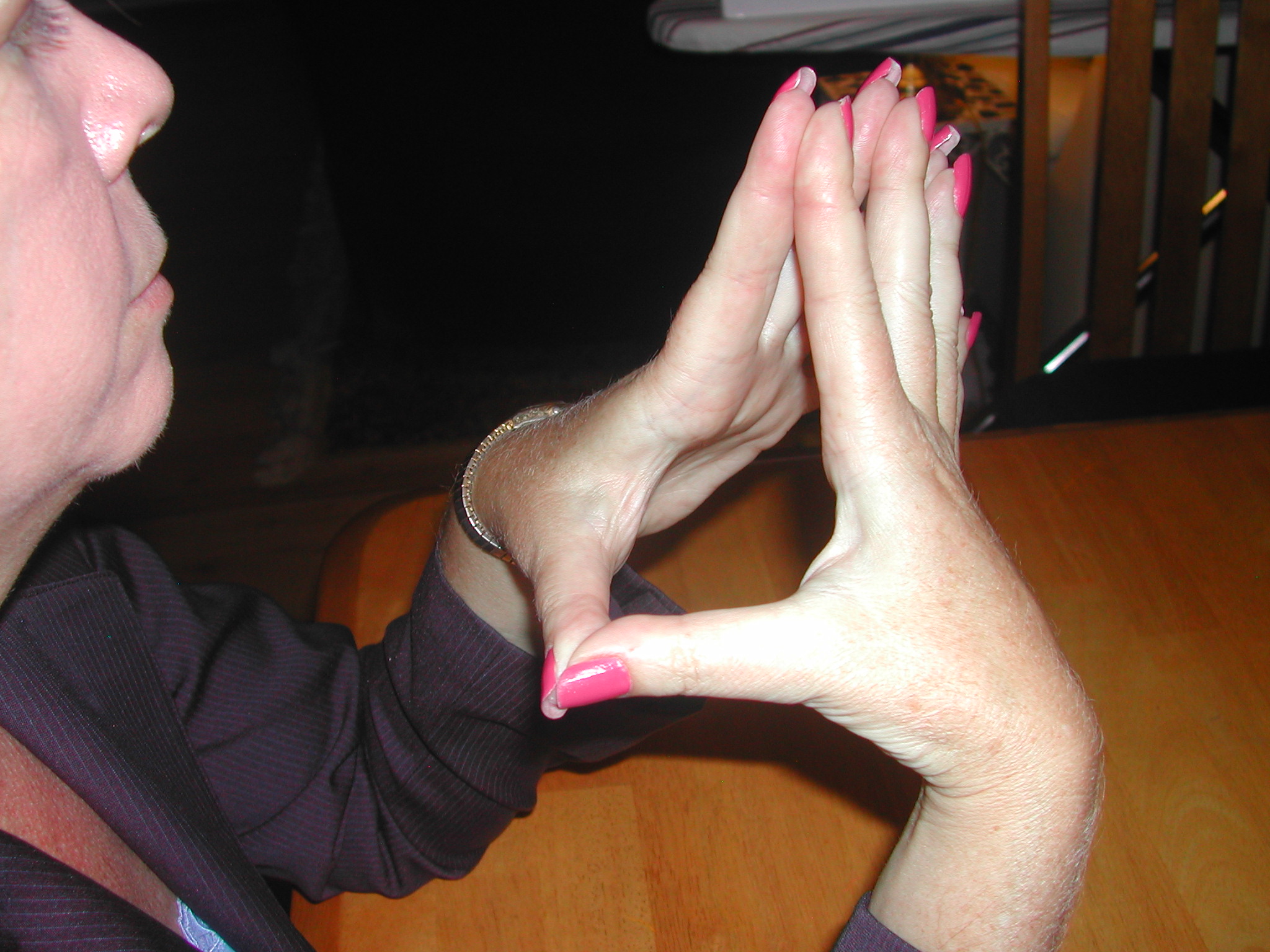
*If you’re sitting at a table, and you steeple your fingers, this can exude power and confidence. However, you have to be careful with this, because fingers in a “gun steeple” can indicate aggressive behavior.


*When talking one on one, do not sit directly across from the person. You’ll both be more comfortable if one of you is off to the side, because you won’t feel like you’re staring directly at each other when you talk.

Lastly, Driver says your intent affects your body language. For example, when you’re nervous, you can make others around you nervous by your body language. On the other hand, if you’re grateful, you’ll likely find the other person more open to what you have to say, because your body language will illustrate this.

Fascinating stuff. For me, I have to be aware of crossing my arms and legs, because I know it gives the wrong impression. What body language do you use that people are misinterpreting? If you really want to know, ask your friends and family. You may be surprised what they say.

What about politicians and elected officials? What about others in the news? Are they being honest? Check out Driver’s blog at www.JanineDriver.com. She does some analyses of people in the news – and gives her insights as to whether they’re lying or being deceptive.

I’d love to hear your body language tips, too. Just post them as comments on the blog. (note: if you post in a linkedin group, your comments will not show up or be retained on the actual blog site)