Public Speaking: 6 Simple Tips for Success

October 1, 2011

A number of years ago, I was in a Board of Directors meeting when my boss unexpectedly called on me to report on the communications department. I had nothing prepared. Nevertheless, I stood and gave an update. After the meeting, my boss explained: “You always get nervous before presentations. I was confident you knew this information thoroughly, so I took a chance that you’d do better improvising. You wouldn’t have time to get nervous.” He was right.

I’m not recommending this approach for anyone, but it did teach me a good lesson, and I’m rarely nervous now before speeches or presentations. The lesson learned? Tip #1, below.

  1. Know your subject matter. Perhaps you’re already an expert, and that’s why you’re speaking. If you’re not, become an expert. This is a must for feeling and sounding confident.
  2. Know your audience, and prepare appropriately. If you’re speaking on IT, you will give a much different presentation to consumers who barely know how to use e-mail than you would to an audience of programmers.
  3. Write out your presentation. Even if it’s only a ten or fifteen minute speech, write out what you want to say beforehand. How many people have you heard speak where every sentence begins with “um” because they have to think about what to say while they’re up there in front of everyone.
  4. Practice, practice, practice. Some people memorize their speeches. Practice enough so that all you need do is glance down at your notes occasionally to stay on track. Memorize most of the speech, but leave enough room to improvise. This will make you look natural.
  5. Be confident. If you’ve followed all the steps above, you’ll come across knowledgeable, interesting, and relaxed.
  6. Enjoy yourself. Look at this as a positive, not a negative. The spotlight is on you, and this is your time to shine.


What Does Your Body Language Say?

July 25, 2011

If you stand or sit with your arms crossed, you’re closed off to what’s being said, right? If someone looks down or off to the side while they’re talking to you, they’re lying, right? Not necessarily, according to Janine Driver, an expert on body language.

I saw Driver speak a few months ago. She’s worked for the federal government, authored books on this subject, and teaches classes and speaks. I’ve also seen her on the Today show a couple times.

According to Driver, many of the old body language myths just aren’t true. She says you have to start with a baseline, and go from there. This works better with people you’ve know for awhile. For example, I’m often accused of being closed off when I cross my arms.  But my friends will tell you that I’m just comfortable standing leaned against a doorway with my arms crossed and my ankles crossed. That means I’m relaxed. An open stance with my legs apart and my arms down by my sides means I’m ready to argue.

If someone never looks you in the eye when they speak, but all of a sudden maintains direct eye contact, this could indicate they’re lying, due to the change. Get it?

The bottom line is to be aware of the body language habits of those with whom you interact. A change in their body language should alert you that something’s not right. Have you ever had that feeling that something is just off? And you don’t know why, because the person is saying all the right things? You just have a bad feeling. Their body language could be sending you signals of which you’re not even aware.

As for your own body language, Driver offered some tips for successful meetings and interactions:

*People like others who they perceive to be like themselves. So, mirror the other person’s behavior a bit. It will make you more likeable.

*Keep your feet flat on the ground during a meeting. Do not cross your legs or ankles. This isn’t because of the old “closed off” idea. Rather, it’s because you will have to uncross or recross them at some point, which will make you look nervous.

*When listening, tilt your head left to look more intelligent; tilt your head right to look more attractive.

*Standing with hands in your pockets can portray confidence, but only if you keep your thumbs out.

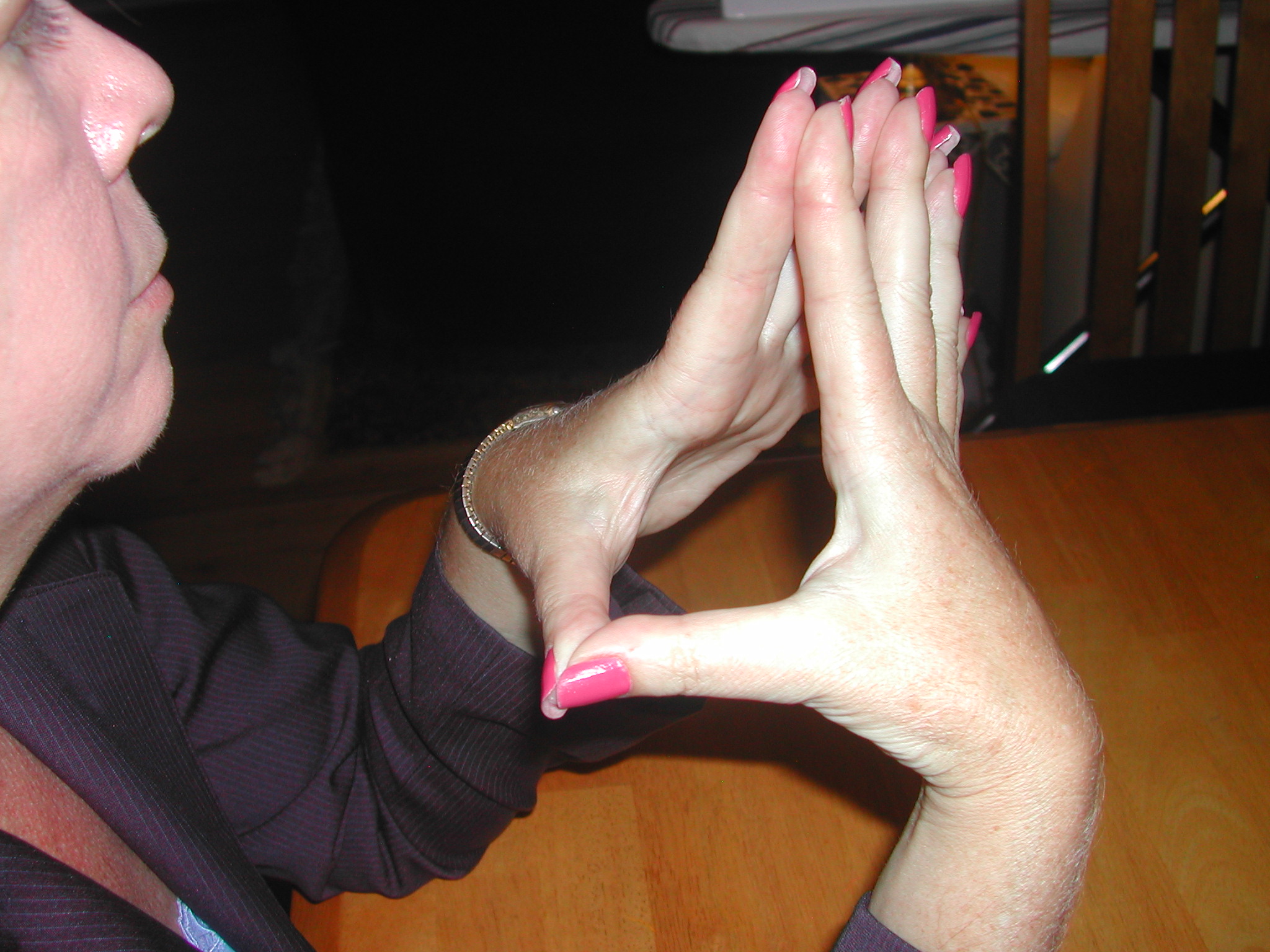
*If you’re sitting at a table, and you steeple your fingers, this can exude power and confidence. However, you have to be careful with this, because fingers in a “gun steeple” can indicate aggressive behavior.

*When talking one on one, do not sit directly across from the person. You’ll both be more comfortable if one of you is off to the side, because you won’t feel like you’re staring directly at each other when you talk.

Lastly, Driver says your intent affects your body language. For example, when you’re nervous, you can make others around you nervous by your body language. On the other hand, if you’re grateful, you’ll likely find the other person more open to what you have to say, because your body language will illustrate this.

Fascinating stuff. For me, I have to be aware of crossing my arms and legs, because I know it gives the wrong impression. What body language do you use that people are misinterpreting? If you really want to know, ask your friends and family. You may be surprised what they say.

What about politicians and elected officials? What about others in the news? Are they being honest? Check out Driver’s blog at www.JanineDriver.com. She does some analyses of people in the news – and gives her insights as to whether they’re lying or being deceptive.

I’d love to hear your body language tips, too. Just post them as comments on the blog. (note: if you post in a linkedin group, your comments will not show up or be retained on the actual blog site)


What’s Your Communication Style?

July 1, 2011

If you’re a fan of Myers-Briggs, then you’ll get a kick out of this, too.

I attended WWPR‘s brown bag lunch a couple weeks ago. The speaker was Carol Vernon, Certified Executive Coach and Managing Principal of Communication Matters.

She has developed four designations for communicators. Perhaps you like the bottom line, or love to get lost in facts and figures. Maybe you’re a storyteller, or you believe compassion is the way to go. Whatever your preferred style, Vernon says you can use it to your advantage, in both your professional and personal relationships.

We all know people we consider good communicators. What traits do they possess? They’re usually friendly, interested, knowledgeable and good listeners. But after hearing Vernon speak, I realize there’s more to it than that. Just like with Myers-Briggs, when you meet YOUR type, it’s such a relief. You feel like you’re with your pals and you can relax. The same holds true when you meet others who communicate the way you do. Perhaps this makes a difference in how you perceive a good or not-so-good communicator?

Here are the fours styles Vernon has spelled out. She does say that no particular style leads to greater success or effectiveness. I believe successful communicators are more likely to morph their styles to fit a particular situation.

  1. Direct – decisive and pragmatic. Tends to speak quickly and formally, with direct eye contact and a firm handshake. Focus is on WHAT needs to be done.
  2. Systematic – analytical and logical. Prefers details like charts and graphs, and looks at processes. Uses precise language. Focus is on HOW to get the job done.
  3. Spirited big picture – storyteller. Excited about ideas and innovation. Very expressive and persuasive. Focus is on WHY the project is necessary.
  4. Considerate – supportive listener. Speaks slowly using soft tones. Values relationships and is more comfortable with workplace closeness. Focus is on WHO is involved.

Why style are you? I identified with all the styles to a certain extent. When I spoke with Vernon about this, she said that some people are able to blend or flex their styles naturally when they interact with people of different styles.

We didn’t take a test to determine which category best suited us. Instead, Vernon asked us to self-identify and then split into groups.

About half of us self-identified as Direct Communicators. Vernon says this is unusual. I wonder if direct-style individuals are drawn to the communications profession? Again, according to Vernon, you will find a certain type of person more drawn to a certain profession, but not necessarily to the exclusion of other types.

Only two of our group put themselves in the Systematic category. Again, Vernon says this is unusual. The styles are usually a bit more spread out. About 25 percent fell into the Spirited category, with the remaining 25 percent as Considerate.

So how can it help to know your style? When you recognize your style and your bosses or colleagues’ styles, you can consciously make an effort to blend or flex your style to better communicate.

For example, when dealing with Direct Communicators, get to the point and answer the question asked. For Systematic Communicators, provide facts and figures. Spirited Communicators need recognition of their contributions. Focus and really listen to the Considerate Communicators.

Interesting, isn’t it? Since I attended this session, I’ve been thinking about the people with whom I interact, and trying to determine which category they fit. With some people it’s easy; with others, it’s not so easy. But it certainly does explain why I feel some people are easier to get along with than others.

Let me know what you think about this. Also, check out Carol Vernon’s web site; she has much more information.


Build Communities Online and Off-line for Successful Public Affairs

May 16, 2011

Communities. Interactions. Relationships. These are the basic tenets of social media.

These are also the basic tenets of a good public affairs plan. Are you implementing these strategies in all your company communications? You should be.

Once you define your message(s) and your target audience(s), you need to build relationships and create communities. It’s easier than ever to do this through social media. But don’t forget about more traditional communications methods like a phone call and an in-person interaction.

Building relationships has always been the key to a successful public affairs program. I’ve never understood the reasoning behind sending out masses of press releases and hoping for some coverage. Instead, I’ve always called, faxed or visited journalists, and set myself and my staff up as resources. Then, when I’m looking for coverage of something in particular, I can contact the journalists I already know. This strategy has always worked.

To understand customers’ needs, we used to conduct surveys and hold focus groups, not to mention simply picking up the phone. I’ve never assumed to know exactly what customers want, without using tools like this.

Then along came e-mail and web sites – much easier ways to communicate with journalists and customers. Now, I can e-mail, blog, text, or comment, in addition to calls or visits.

The advent of e-mail, websites and the subsequent online communities, such as FaceBook, LinkedIn, Twitter and YouTube, has made this process much easier. It has also propelled the idea of building communities to the forefront of companies’ communications plans.

It’s about time. I’ve been spouting this philosophy for years, much to the consternation of some former bosses and colleagues. Perhaps now they get it.


How are you getting your message out?

March 6, 2011

As a professional communicator, I utilize differing dissemination vehicles, depending upon the company and the message. Vehicles include traditional means, like newsletters, press releases and ads, along with electronic methods. A good marketing communications plan analyzes all the possible dissemination methods and capitalizes on the ones that will best reach target audiences. Below is a short list of ways to communicate your message. What would you add to the list?

newsletter or magazine

press release

advertisement

media relationships – press coverage

community relationships

industry group memberships

web site

e-mail

e-zine

LinkedIn

Twitter

FaceBook

blog

word of mouth

public speaking

networking/one-on-one meetings

events